EVOSST Policy Brief Sets Out Early Directions for More Accessible and Impact-Oriented Social Services
The EVOSST Horizon Europe project has developed its first Policy Brief, setting out early policy directions for more accessible, coordinated and impact-oriented social services. The Policy Brief brings together evidence from the project’s research activities and input from stakeholders who participated in the EVOSST Policy Roundtable held in Western Macedonia, Greece.
The Policy Brief highlights the need to move beyond evaluating social services mainly through administrative indicators such as the number of people served, service volume or cost. Instead, it points towards a broader approach that considers the actual impact of services on people’s lives, including their well-being, autonomy, social inclusion and access to support.
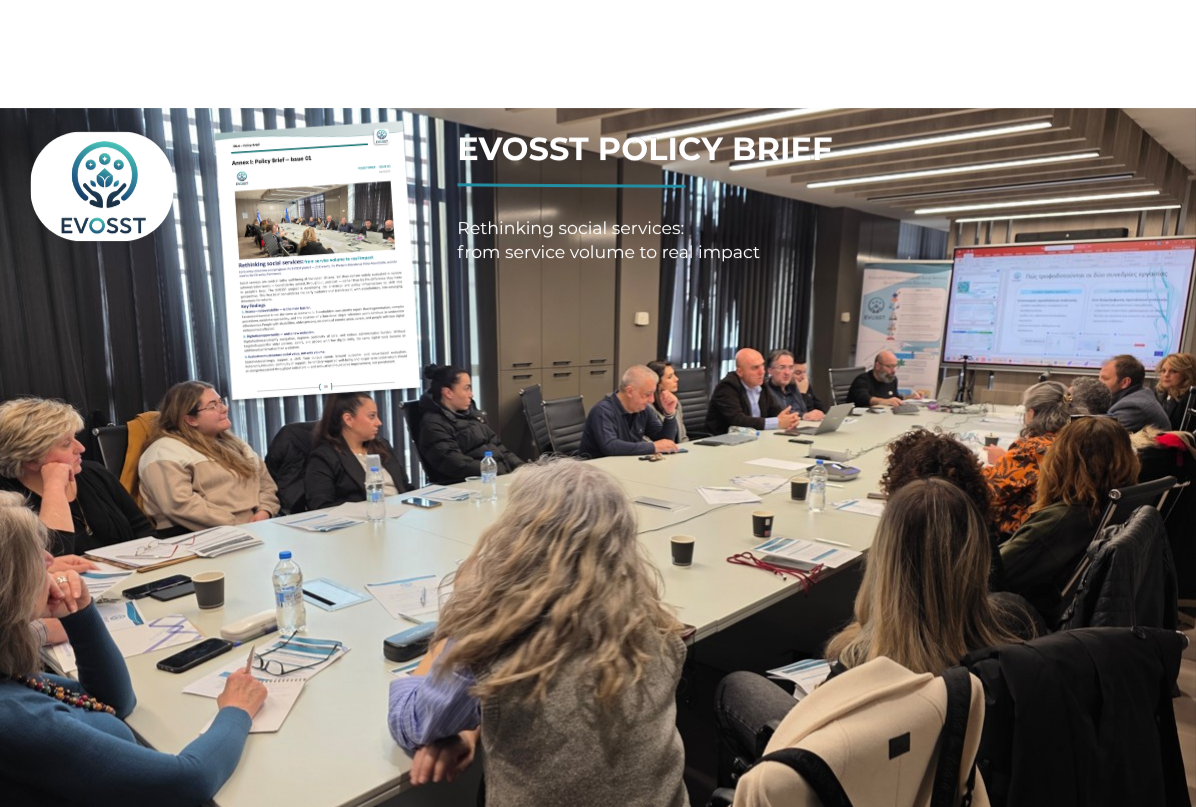
A key source of stakeholder input for the Policy Brief was the EVOSST Policy Roundtable, held on 31 March 2026 in Kozani, Greece. The hybrid event brought together around 40 participants from public administration, municipal social services, academia, NGOs, frontline support structures and organisations representing people with disabilities to discuss current challenges in social services and help shape preliminary policy recommendations.

The discussions highlighted several recurring challenges affecting access to and the effectiveness of social services. Participants pointed to fragmented service pathways, complex procedures, limited coordination between services, physical and digital accessibility barriers, and difficulties in finding clear and reliable information. These challenges were seen as particularly important for people with disabilities, older persons, residents of remote areas, carers and people with low digital skills.
Building on these findings, the Policy Brief identifies five emerging policy directions: improving access to social services through a more integrated first-contact approach; strengthening coordination and interoperability between services; moving towards evaluation models that focus on outcomes and social impact; investing in the training and professional support of social services staff; and involving beneficiary organisations and civil society more systematically in the design and evaluation of services.

This approach reflects EVOSST’s broader work on developing ways to assess the social value and longer-term impact of social services. By combining evidence on well-being, social inclusion and autonomy with wider social and economic considerations, the project aims to support a more comprehensive understanding of the value that social services create for individuals and communities.
These policy directions are not intended as final recommendations. They will be further discussed and refined through additional stakeholder engagement and policy workshops in Greece, Belgium, Bulgaria and Romania. The evidence and feedback gathered through this process will contribute to the development of the final EVOSST Policy Framework, which will bring together the project’s research findings and stakeholder perspectives into an evidence-based policy framework for social services at European level.
The first EVOSST Policy Brief translates the project’s early research and stakeholder dialogue into practical policy-oriented insights. As the project continues, further evidence and stakeholder input will be used to refine these directions and support the development of a policy framework aimed at improving the accessibility, quality and impact of social services across Europe.
Read the EVOSST Policy Brief – Issue 01
Explore the full Policy Brief and the early policy directions emerging from EVOSST research and stakeholder dialogue.
View / Download the Policy Brief [PDF]
About EVOSST
EVOSST (Evaluation and Valorization of Social Services for a Sustainable Transition) is a Horizon Europe research and innovation project that aims to improve the evaluation, monitoring and development of social services across Europe. The project develops innovative life-course impact assessment models, enhanced well-being measures and an expanded Social Return on Investment (SROI) framework to better understand the long-term effects of social services in areas such as healthcare, education, childcare, long-term care and social inclusion. By integrating digital technologies, including Artificial Intelligence (AI) and Virtual Reality (VR), EVOSST supports evidence-based decision-making, promotes social inclusion and contributes to more effective, sustainable and user-centred social services.
EVOSST project has received funding under the European Union’s Horizon Europe research and innovation programme under Grant Agreement No 101178789.

Download the press release here: EVOSST Policy Brief Sets Out Early Directions for More Accessible and Impact-Oriented Social Services
Interested in updates like this?
Subscribe to our newsletter to stay informed about EVOSST activities, results and policy developments.